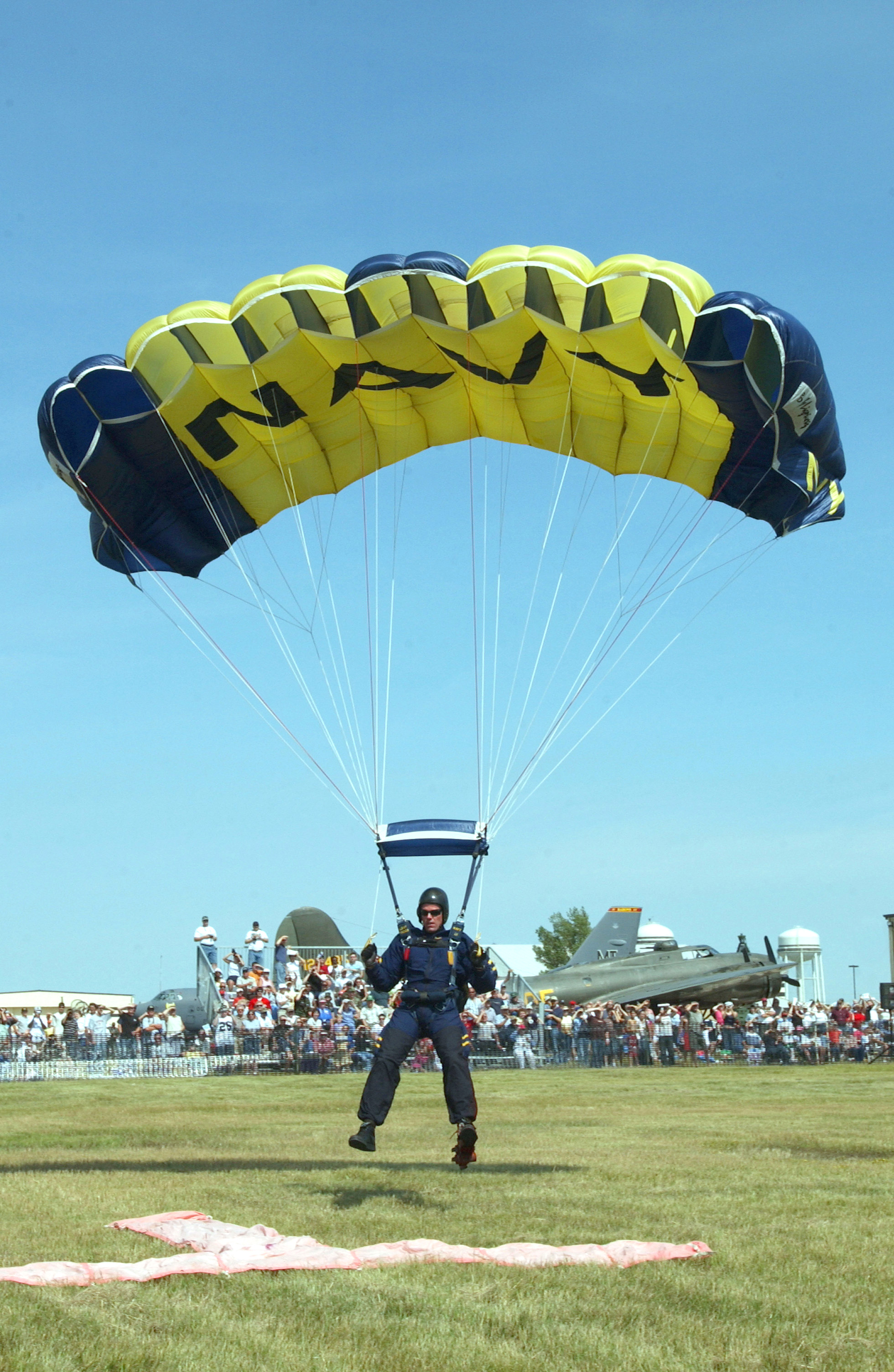
I’ll be honest. Unless it was absolutely necessary, I’m probably the second to last guy to jump out of a perfectly good airplane. I say second to last, because the guy behind me is going to have to push me out before he goes. Not really surprising for a person who isn’t even all that into roller coasters. Despite that, I do still maintain a healthy interest in things that scare me. Statistics show that skydiving is less risky than driving your car around – you have a 0.0007% chance of dying while skydiving, and a 0.0167% chance of dying in a car accident. You can add that to the list of things that are safer than driving, like swimming with sharks or going on a date with that girl with the weird obsession with horses. Skydiving is one of those activities that just goes to show how far humankind is willing to go to prove ourselves against nature, and is also a gleaming example of exactly how crazy we are.
Let’s take a look at how we even came up with this idea, how we carry it out, and what keeps people from becoming meat-bullets.
The History
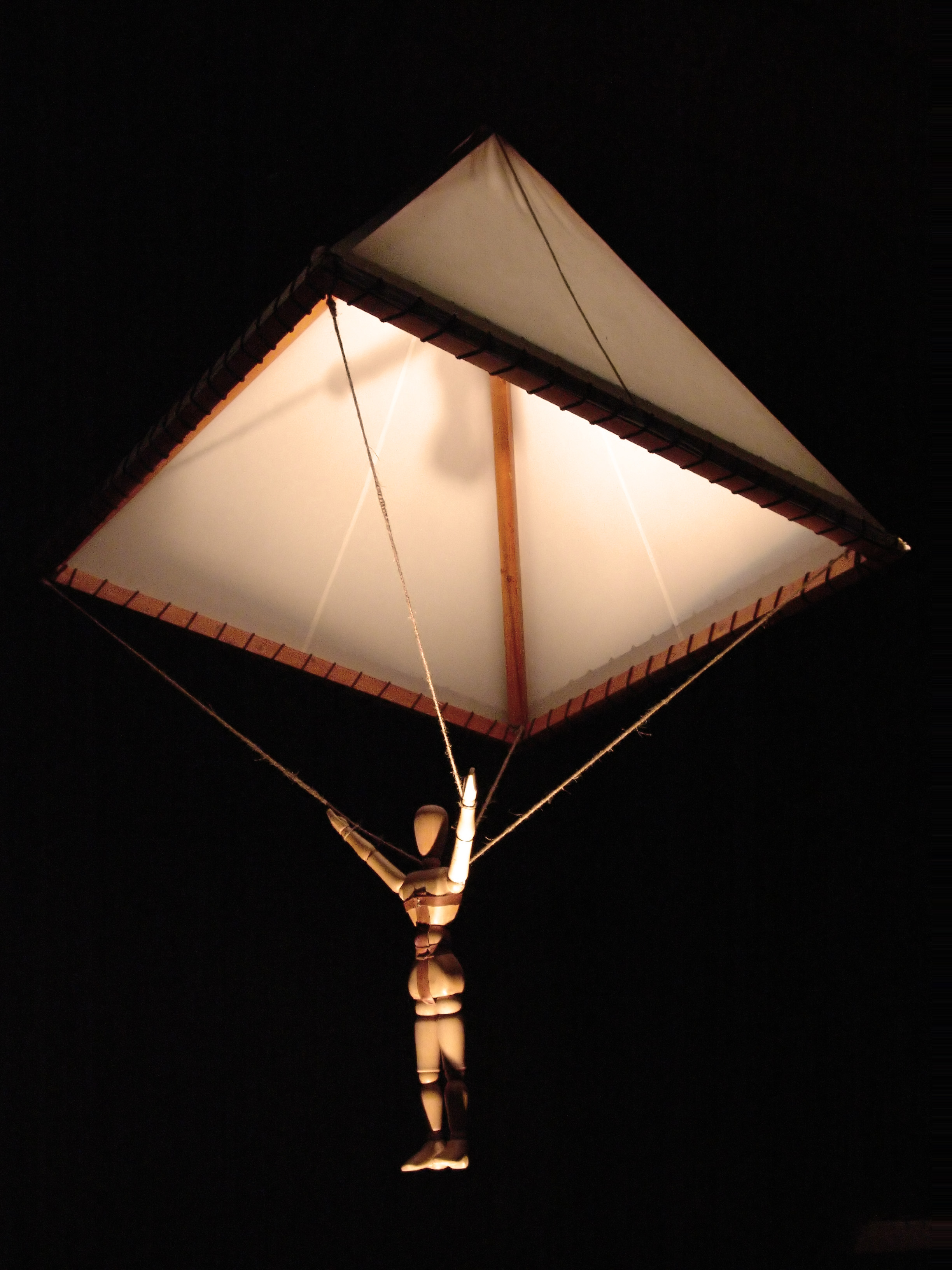
Looking back into history, it’s clear to see that people have always been enthusiastic about throwing themselves off of tall things. Some evidence shows the earliest attempts of using parachutes goes back to 1100’s China, but it’s more commonly accepted that they were being experimented with during the Renaissance. Early designs were rigid pyramidal or conical objects unceremoniously strapped to whoever was foolish enough to leap off a tower with one, and usually led to the wearer’s death. In 1495, Leonardo DaVinci drew up designs for a large wooden pyramid that attached to its victim by way of four ropes at the corners. A man named Adrian Nichols had one built and tested it in 2000, but cut it loose and used his own modern parachute for fear of being crushed by the thing. Other than that though, it technically worked for a while.
Soon after the invention of the soft fabric parachute, the development of modern skydiving began in Europe in the 18th century. Performers would strap themselves in and jump from high flying balloons for crowds of spectators below. During World War I, parachutes were used by the crews of observation balloons to bailout. World War II saw the advent of the paratrooper on the battlefield, a tactic which allowed Allied forces to gain an advantage on the field. Skydiving as a form of recreation came soon after the wars, as veterans began to experiment with jumping for fun, instead of out of panic. Skydiving schools began popping up all over the place, along with research into controlled freefall, which we’ll talk about in a bit here.
Many of you probably remember this guy.

That’s Felix Baumgartner, Austrian daredevil and official bad-ass. On October 14, 2012 he broke the world record for the highest skydive at an altitude of 39 km (24 mi) in Earth’s stratosphere. Baumgartner jumped from a helium balloon in a pressurized suit, and plummeted toward the earth with a top speed of 843.6 mph, or Mach 1.25 – 1.25 times the speed of sound. Felix Baumgartner is the first human to break the sound barrier outside of a vehicle or under the power of a vehicle.
Check out the video. He just keels out of that capsule like it’s just another lazy Sunday.
Anyone recognize this guy?

Probably not. That’s Alan Eustace, a computer scientist and Senior VP of Google. He nonchalantly broke Felix Baumgartner’s altitude record in October 2014, jumping from 41.4 km. For reasons that I can’t comprehend, no one seemed to care. Sorry Alan.
The How
So, how does one go about skydiving? The first part is pretty straightforward – jumpers ride an airplane or helicopter to altitude (usually around 13,00 ft or 4000 m above the ground). When they reach their target altitude, they jump out and begin what is known as free-fall. Technically, free fall is the motion of an object when it is subject only to the force of gravity. Because skydivers experience air resistance (thankfully), they never really experience real free fall, but we’ll let it pass because it sounds cool. The aforementioned air resistance or drag starts to push back against the force of gravity and pushes more and more the faster the jumper goes. At a certain point, the force due to air resistance and the force due to gravity are equal and opposite, and without the influence of other forces, a skydiver will cease to accelerate. The speed that a skydiver is travelling at this point is called terminal velocity, and it’s dependent on a few different factors, which we’ll talk about later on. The point is, you will eventually reach a point at which gravity can’t cause you to go any faster. Skydivers often describe being at terminal velocity as feeling like the air is holding you up or that you’re being supported by a cushion of air underneath you.
 Once a jumper reaches a certain altitude, which they can monitor with the use of an altimeter, they deploy their parachute. This is achieved with a small round parachute called a pilot chute. It’s packed in a small pouch or pocket and is attached to a cord, on which is mounted the pin that deploys the main chute. The pilot chute is thrown out, the line yanks the pin free, and the carefully packed main chute is free to catch the air and slow a jumper down by way of increased drag. If none of that works, well…grow some wings.
Just kidding, everyone carries a reserve chute just in case something goes wrong. If THAT doesn’t work…then grow some wings. For real though. Don’t mess it up. Parachutes are packed CAREFULLY to ensure that they will deploy correctly (or at all), and reserve chutes are packed and inspected by FAA certified riggers. Most malfunctioning parachutes are caused by human error, not mechanical failure.
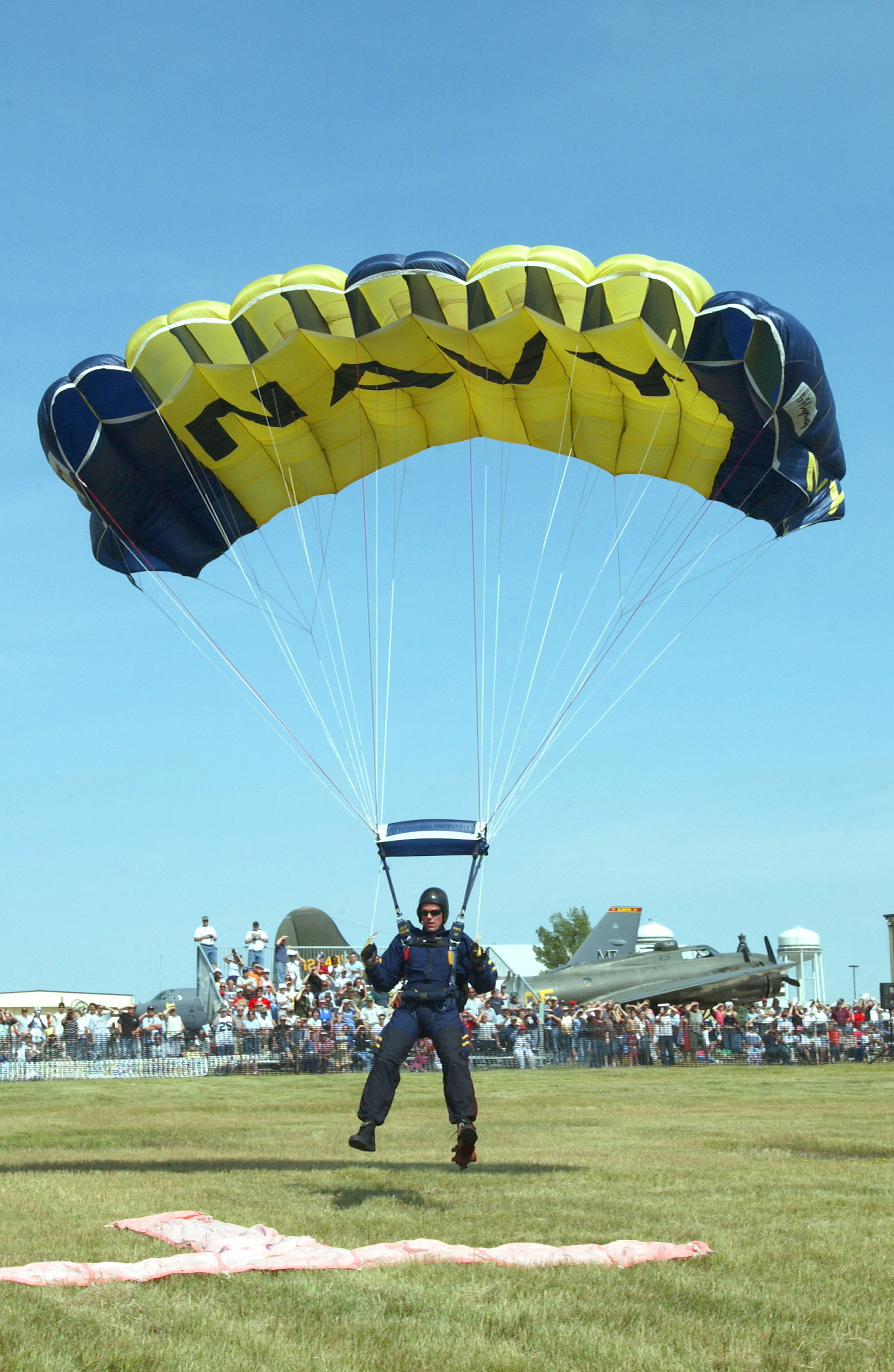
A lot of you guys are probably imagining those big, round parachutes you’re used to seeing, but modern skydivers use what is called a ram-air parachute. These parachutes are those rectangular ones that inflate when air passes through the tubes that make up the parachute and act like an airplane wing. Ram-air parachutes are controllable and steered by pulling on lines that change the shape of the parachute; pulling on both lines causes the parachute to slow the jumper down. They allow people to accurately and safely land in their target zone.
 What makes skydiving safe? It’s the fact that we have an atmosphere that’s nice enough to lend us a hand in not dying. Drag prevents us fragile humans from becoming meaty water balloons by giving us a top speed, and rendering further assistance by lowering our top speed when parachutes are deployed. If you jumped from a plane without it, gravity would run amok, and you would reach the ground at a screaming (literally and figuratively) 336 m/s, or about 752 mph. That’s almost the speed of sound. It would be unpleasant, to say the least.
Our top speed of falling is determined by balancing forces, a story that brings us all the way back to the good ol’ Renaissance.
The Physics
I’m sure everyone here remembers the story of Galileo and the Leaning Tower of Pisa. If you weren’t taught that one in school, let me refresh your memory. The story goes that Galileo Galilei (Italian Renaissance science-guy) conducted an experiment: he dropped two cannonballs of different masses from the top of the Leaning Tower of Pisa to see if they would fall at different rates. When they hit the ground at the same time, he proved that all objects accelerate toward the Earth at the same rate regardless of mass. The force of gravity on an object depends on two things – its mass, and the gravitational acceleration constant. On Earth, that would be about 9.8 m/s for most objects. An equation for that looks like:

where 


Of course, we also all know that this experiment doesn’t take into account air resistance, or at least the conditions (spherical objects and low speed) make that consideration negligible. For skydivers, drag is important, and described by the drag equation:

where 


The amount of drag experienced by a skydiver is dependent on the mass density of air in the atmosphere (how “thick” or “thin” the air is), the flow velocity or how fast the air is moving past him, his drag coefficient, which is a number that describes how easily he can slip through the air, and area, the amount of his body he exposes to the oncoming air. Let talk about these one by one.
The density of air in the atmosphere comes into play here because it’s not the same at every altitude. Air becomes less dense with altitude, so the higher you go, the less drag force you’ll encounter. Like we mentioned before, drag is dependent on velocity – the faster you’re traveling, the more drag you’ll get. Drag coefficient and area are related – for a specific body shape and size, you’ll present a particular area to the oncoming air, which will change your drag coefficient. Skydivers can change their drag coefficient by altering the shape of their body during the jump. If they decided to act like a pencil, they’d fall much faster than the classic belly-to-earth spread position you think of when you imagine a skydiver in free fall. So if you’re an adrenaline junkie, why wouldn’t you want to go as fast as you could go? It turns out that the spread position doesn’t just keep you going slower, but also allows for greater control during a jump. The last thing you’d want to do is be in an uncontrollable careening downward tumble.

I mentioned before that terminal velocity is the point at which the force of gravity and drag force balance out. When we’re talking about the equations, that means that those forces are equal, and can be written thusly:


The minus sign in front of the drag equation signifies that it’s acting against the force of gravity. If we want to know what our velocity at this point is, then we just solve for

where 
If you watched the video above about Felix Baumgartner’s jump and kept an eye on the velocity meter, you may have noticed that his speed peaks early on, then slows down over the course of his jump. This illustrates the effect that altitude has on the density of air up there. Felix was traveling through very thin air at the beginning of his jump, which allowed him to experience little drag and reach high speeds on the first part of his trip. Unfortunately, it also meant that without much air for his body to grab onto, he was unable to achieve a stable position until he reached thicker atmosphere, and caused him to tumble around a lot at first. Scary.
I find that learning more about how something works pulls back the fog-o-fear that surrounds something. For instance, when I learned that the glass floor in the CN Tower in Toronto was exceptionally strong, I became much more comfortable stomping on it to scare other people. Maybe this skydiving thing wouldn’t be such a bad idea after all…
I hope you enjoyed reading The Physics Behind…! Have some feedback? Awesome! I would love to know what you thought about this article, if you have any questions, and if you’ve got any suggestions for future posts. See you next week!
Sources: 1 2
Images: 1 2 3 4 5
*I’ll be the first to admit that I l actually love Nicholas Cage.
 The Physics Behind