Ah, Wilhelm Wilhelm Wilhelm. It seems fitting that the first of our Legendary Laureates is the first person to receive the coveted Nobel Prize in Physics. In case you’ve been living under a rock, the Nobel Prize is presented (almost) every year to five recipients who have made contributions benefiting mankind in the fields of chemistry, physics, literature, peace, and medicine. Laureates are determined by Swedish and Norwegian committees, and prizes can be shared between winners. It was all started by Alfred Nobel, a wealthy inventor who is best known for coming up with dynamite. Upset that his legacy would be as a merchant of death, Nobel stated in his last will that his fortune would be used to fund the creation of the Nobel Prizes.
Wilhelm Röntgen was on a very short list of people considered for the first Nobel Prize, and was awarded his medal in 1901. The reason for all of this? He discovered what some called Röntgen Rays – today, we call them x-rays. To say the least, they’ve been extremely beneficial to mankind.

The History
Let’s take it back. Wilhelm was born in 1845 in Germany, the son of a draper – his father basically made and sold cloth. His parents sent him off to boarding school and later to a technical institute, where he was expelled for drawing cartoons of his teachers, which he didn’t even do. That really puts the pop-tart handgun incident to shame.
Nevertheless, Röntgen somehow entered the University of Utrecht at the age of 20 to study physics, then decided that he would move to another school. He didn’t have the necessary credentials, but knew that he could get in if he just passed an exam. So, he just…did. He just tested into the University of Zurich. Even better, a mere 4 years after he started schooling, he came out with a PhD in mechanical engineering. Did they just hand out PhD’s back then? Or did Röntgen basically have the greatest academic comeback story in history? Who knows. He spent the next years of his life jumping around through universities in Germany teaching and running physics departments.
Röntgen’s first works were published right after he received his PhD. He studied the specific heat of gasses, the thermal conductivity of crystals, looked at the electrical properties of quartz, the properties of fluids under pressure – there was no stopping this guy. Eventually though, he settled on the one thing that bewildered him the most.
The How
In November 1895, Wilhelm Röntgen was doing some work with cathode ray tubes (specifically, Crookes tubes), hollow glass tubes filled with gas at low pressure with a metal contact at each end (a negatively charged cathode, and positively charged anode). The discovery of the electron won’t happen for a couple of years, so scientists working with cathode ray tubes at the time didn’t know exactly what was happening. But we do now! When you apply high voltage, the gas inside the tube ionizes and sheds electrons. These electrons are accelerated by the electrical field present in the tube, and go flying off toward the positively charged anode at around 20% of the speed of light. Because of the high speed, electrons often travel past the anode and slam into the glass at the end of the tube, causing it to glow or fluoresce. This happens when incoming electrons collide knock the electrons in the glass atoms up to higher energy levels. When they fall back down, they release energy in the form of light.
OR DO THEY?!
The Physics
Well they do, but something else also happens.
Wilhelm was just screwing around with a cathode ray tube one day and noticed that even when he had one enclosed within a light-tight box, he still witnessed a piece of cardboard painted with fluorescent material glowing when he brought it close to his experiment. Puzzled, he promptly stuck his wife’s hand right in the way of this potentially dangerous new discovery.
Not really, he kept experimenting with different materials of varying thickness to put in between the box and his fluorescent target. he noticed that thicker materials caused less visible marks on the target, and that different materials reacted differently to the experiment. Röntgen, the grade-skipping smart cookie that he was, reasoned that there must be some new kind of ray going through here…….some kind of…..X-RAY….

He figured this out, THEN stuck his wife’s hand in the way to see what would happen. What’s the worst thing that could? This is the world’s first röntgenogram, or as we know it, an x-ray image. It was taken by Röntgen, and shows his wife Anna’s wedding ring, flesh, and bones. Not kidding this time. This image clearly demonstrated the effects of different materials on the travel of x-rays through them.
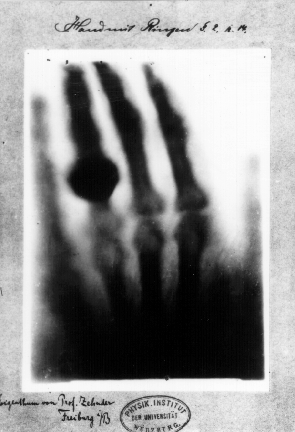
It wasn’t until later that physicists ascertained that these x-rays were in the same class as ordinary light, but with much shorter wavelengths (or much higher frequencies, which ever you prefer). Röntgen gained instant fame for his discovery, and was showered with awards and high fives. He was awarded the Nobel Prize in Physics “in recognition of the extraordinary services he has rendered by the discovery of the remarkable rays subsequently named after him.”
Despite all of this, he remained a very modest and amiable dude. He didn’t even name Röntgen rays after himself, other people did; he named them x-rays (or rather, x-radiation) because of their unknown nature. Wilhelm loved the outdoors, was an avid mountaineer, and enjoyed spending summers at his vacation home in the foothills of the Bavarian Alps. To make sure that others could continue researching x-rays, he never took out patents for his apparatuses (most of which he built himself with that handy mechanical engineering PhD), and donated the money he won from the Nobel Prize to the University of Würzburg. He and his wife adopted a daughter, and he lived his last years at his country home near Munich. Röntgen died in 1923 of carcinoma of the intestine, bankrupt from the aftermath of WWI inflation. It believed that Röntgen’s death was not related to his work with ionizing radiation, because he was one of the few pioneers in the field that regularly used a lead shield to protect from harmful x-rays.
Wilhelm Röntgen’s contribution to science and medicine can still be seen today, when doctors take a look at what can’t be seen from the outside. At the end of it all, he was a man who was dedicated to science, helping others, loving nature, and remaining grounded in the face of fame.
I’m glad he was such a cool guy. Rock on, Röntgen. Rock on.
I hope you enjoyed reading The Physics Behind…! Have some feedback? Awesome! I would love to know what you thought about this article, if you have any questions, and if you’ve got any suggestions for future posts. See you next week!
Sources: 1 2 3 4 5
Images: 1 2 3 4
Tune in next week for a more thorough discussion of x-rays!
 The Physics Behind