I’ve played in my fair share of rock bands, and constantly heard guitar players tout on and on about their “awesome tube amps, dude” and how “they just sound so much warmer” and “nah, I can’t go out tonight, I spent too much money on my tube amp.”
Vacuum tubes don’t just reside in guitar amps though. Apart from their use in audio equipment, vacuum tubes were used in just about every bit of electronic equipment until about the 1960’s. For almost 50 years vacuum tubes ran the world before giving way to solid-state electronics. Today, they still have their uses and have been generally reduced to serving in specialty applications, but anyone paying attention to vintage stuff knows that they’re making a comeback.

Here, we’ll take a look at the application of vacuum tubes over time, how they work, and what makes them do that shiny glow-ey thing.
The History
The 1800’s saw a fair bit of experimentation with evacuated glass tubes – aside from the light bulb however, most work done on these tubes was only out of curiosity. It wasn’t until 1904 that English physicist John Ambrose Fleming created the first vacuum tube diode – a device which allows electricity to flow in only one direction. The invention of the triode (I’ll explain what this all means later) by American inventor Lee De Forest 3 years later launched the age of electronics – these vacuum tubes were in practically every electronic device at the time. They allowed electrical signals to be amplified, radio signals to be detected, the first computers to be constructed, and revolutionized telecommunications.
In short, they were pretty awesome.
But they weren’t without their flaws. For example, jostling vacuum tubes can affect the outgoing signal, turning the thing into a microphone. They were prone to wearing out, and early computers had to have vacuum tubes replaced constantly. Vacuum tubes get hot, they use up a whole lot of energy, and they’re huge compared to their modern successors. These days, semiconductor transistors have replaced vacuum tubes in just about every way – they’re more reliable, cheaper, smaller, more durable, and more efficient.
Why then, do we keep vacuum tubes around at all? Vacuum tubes can withstand high voltages for a long time, while semiconductors might burn out within a few microseconds under similar conditions. Their construction lends them a few advantages, and allows them to keep their place in the modern world. They’re still useful for some things – many audiophiles still prefer the sound of a good old tube amp.
Let’s take a look inside.
The How
In case you’ve never seen one, vacuum tubes are made of a capsule (usually glass, though metal ones exist too) that contain some number of electrodes (described as metal plates or grids), perhaps a heater, and literally nothing else. As the name suggests, the inside of a vacuum tube is a vacuum – devoid of any gas. Ideally, at least. When they were first under development, it was thought that a small amount of gas was needed to make them work; it was later found that the opposite is true, and that having any gas inside the tube would cause a vacuum tube to work inefficiently.

At the very least, a vacuum tube must have a cathode and an anode. The cathode – originally a filament heated by running a current through it – gives off electrons by the process of thermionic emission. These electrons (negative charges) are attracted to the anode, which is charged positively, and can move across the vacuum in only that direction until they reach that anode, due to the electric field created between the cathode and anode. These vacuum tubes have two electrodes and were thusly named diodes – this term has stuck around, and describes any device that restricts the flow of electrons to only one direction.
Newer tubes employ a separate heating element to heat the cathode. It’s this heating action that gives vacuum tubes their signature glow.

Somewhere along the way, Lee De Forest got clever and added a 3rd electrode – a grid that sits between the cathode and anode. This bit of metal allows electrons to pass through it, but if you apply a negative charge to it, can keep electrons from reaching the anode (the like charges repel). Now, we have a way to control the output of the vacuum tube – an on/off switch. What if you only apply enough voltage to the control grid to allow some electrons through? Then, you could vary the output of the tube. Voila! An amplifier is born!
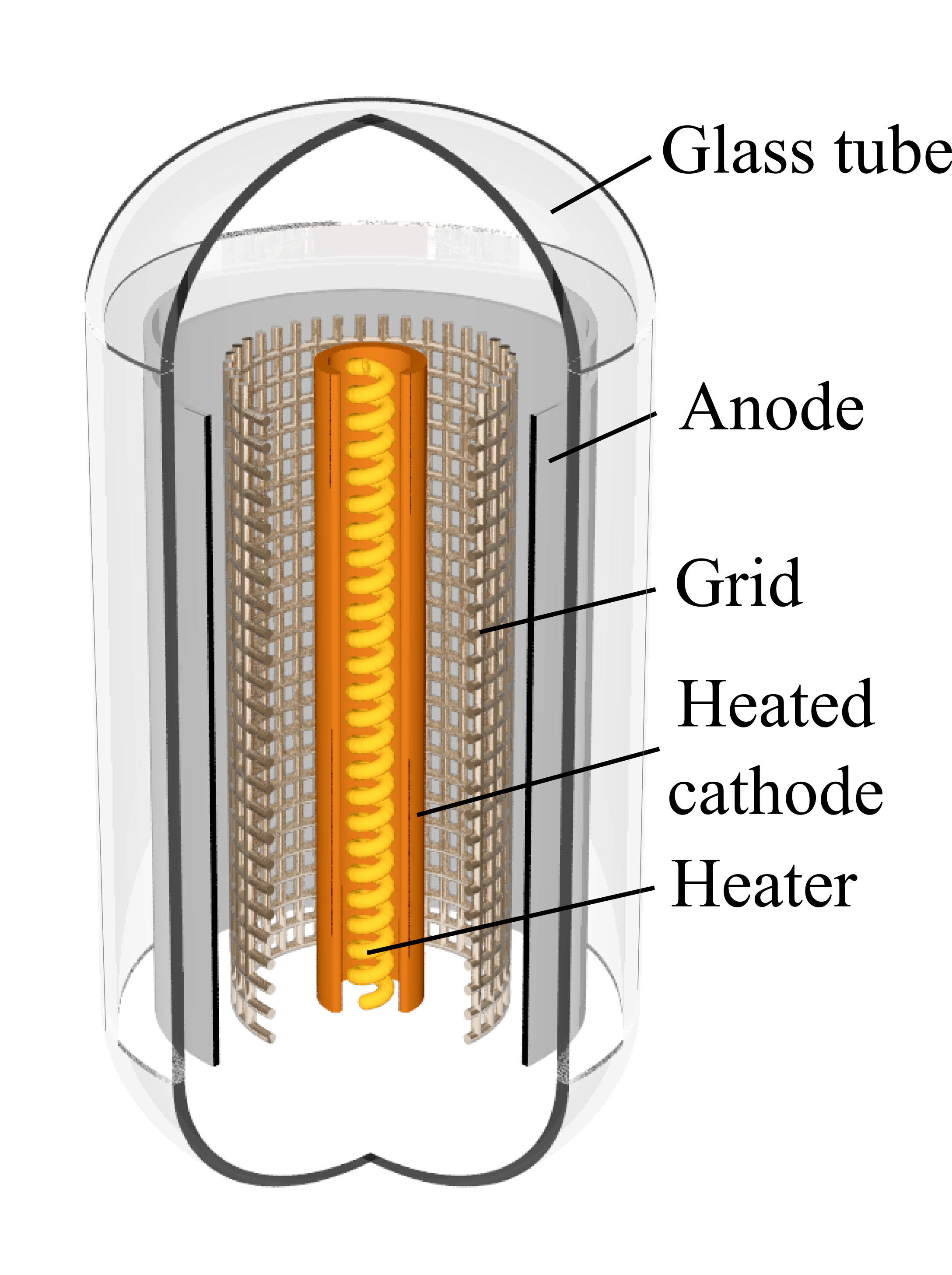
If you’re having a hard time visualizing how this works, imagine that you have a garden hose. The water flowing through is like the flow of electrons across a vacuum tube – slapping a valve on the end is like adding a control grid, and the amount that you open that valve is like an input signal. When you open the valve, water flows freely; when it’s closed, no water can flow. Any level of “openness” in between is then translated to the flow of water out of the hose. It’s not a perfect analogy, but you can see how a small change in the input signal can produce a large change in the output signal. A few electrons in the form of say, the signal from a guitar, affects the flow of a lot more electrons that become the output signal.
What makes those electrons pop off the cathode in the first place?
The Physics
While trying to figure out why the filaments in his light bulbs were breaking, Thomas Edison ran an experiment: he heated a filament, and placed next to it a charged plate hooked up to a galvanometer, a device to measure current from the plate. When the plate was charged negatively, there was no current coming through the plate. When it was positively charged, the current flowed. He named the effect after himself and in typical Edison fashion, filed a patent for a voltage regulating device in 1883 despite not understanding the underlying physics, since electrons won’t be identified for another 14 years. Fun fact, if boring facts are fun to you: this patent is the first U.S. patent for an electronic device, and lit the fire for that whole Apple-Samsung debacle – which unless you’re reading this from the past, is a ridiculously outdated reference for me to make right now.
Moving on!
It wasn’t until after 1897 when J.J. Thompson identified the electron as a separate particle, that Owen Willans Richardson started work on what he called thermionic emission (I guess he had some beef with calling it the “Edison Effect”). Richardson’s experiment noted that the current from a heated filament depended on the temperature of the filament and in 1901 proposed this equation, called Richardson’s Law:

,where 


The Nobel committee thought this was pretty cool, and awarded Owen Willans Richardson the Nobel Prize in Physics in 1928.
In case you don’t remember from the solar panel article, the work function describes the amount of energy that an electron must have before it is ejected from a metal’s surface. What’s important to look at here is the temperature of the cathode. When the cathode of our vacuum tube is heated, the thermal energy contributes to the energy of the electron – when there’s enough, that electron can overcome its binding potential (work function) and is sprung from the surface – the higher the temperature, the more electrons are released. These electrons are then free to move under the influence of the electric field created by the positively charged anode until they reach said anode and become the output signal. As was said before, the flow of electrons can be regulated with the 3rd electrode (the control grid) by an input signal, and the resulting output signal is turned into music for our ear-holes.

Beyond diodes and triodes, there are tetrodes, pentodes, hextodes, heptodes, octodes – so many todes! Manufacturers produced an endless number of different types of vacuum tubes, each with it’s own confusing name and designation. All the different “-todes” refer to the number of additional electrode screens added to the tube (just like a triode means that there are 3 electrodes, a pentode means there are 5) in order to control the quality of the signal. I won’t delve too much into it, but the extra grids are placed in an effort to control a capacitive effect generated by the vacuum tube’s electrodes. In the end, the fancy vacuum tubes with all the pins result in a cleaner signal at the output.
So what exactly is it with audiophiles and vacuum tubes? It’s said that the amplified signals that vacuum tubes produce are warmer, more balanced, and more rounded than those produced by solid-state amplifiers. It’s not that sound from tube amps is better or more accurate, many simply argue that it sounds better to them. For that reason, many people are beginning to switch back to using vacuum tube amplifiers and audio gear and away from solid-state stuff. It’s kind of like all of those super-processed foods that were invented back in the 50’s; people liked them for their convenience, but in the modern age, have started to grow weary of canned cheese. Personally, I’m excited to see some old technology coming back. It’s nice to see people value quality over convenience every now and then.
P.S. If you want to see a great video about the role of vacuum tubes in computing, I highly suggest watching this video from Tested.com’s YouTube channel. Bonus: it features Mythbuster’s Adam Savage!
I hope you enjoyed reading The Physics Behind…! Have some feedback? Awesome! I would love to know what you thought about this article, if you have any questions, and if you’ve got any suggestions for future posts. See you next week!
Sources: 1 2 3 4
Images: 1 2 3 4 5
 The Physics Behind


