You knew it would eventually get pretty mundane, and this week, we’re going there. I personally find it interesting when people are really really passionate about mundane things. Even if it doesn’t interest me, there is a certain fascination in hearing someone go on about the history of aerosol cans, or the different types of glue used on stamps over the years. You know, the kind of information you wanted nothing to do with as a kid. But even kids have it. I’m sure you’ve had to sit through a conversation with your nephew going on and on and on about the different evolutionary outcomes of Eevee or something. There are a lot more now than there were when I was growing up apparently.

What’s more mundane than road signs? Politics? Cheese? At least these are objects that you might hear a conversation about at some point. No one really ever stops to think about road signs. There is really only one way that they’d yield an interesting article, and that’s by merging the topic with a cool little experiment that measures the distance between Earth and the Moon called the Lunar Laser Ranging Experiment (LLRE).
What do they have in common? Well let’s find out! This week, all about the history, special properties, and relationship to the moon that road signs have.
The History
Before we had road signs, people got lost a lot. They had to navigate with the stars, rely on wonky charts drawn by Joe back in Tyre, and mostly milled around the desert aimlessly until someone had a hallucination and decided to just stop somewhere. The advent of roads built by Romans also ushered in the first road signs – milestones, stone or concrete posts placed on roads that displayed the distance from Rome. Soon after, wooden signposts pointed travelers in the direction of nearby towns and cities. Eventually, they started to display the things we all know and love: road rules, distances, road features, STOP. Cast iron signs were popular until they were replaced with lighter materials like aluminum and steel. These days, signs are made of a sheet aluminum backing plate lined with a plastic sheet with special reflective properties – retroreflectors. These crazy little things are what give signs that signature reflection pattern, and their design improves visibility while preventing the whole highway from lighting up like the Las Vegas strip.
The How
So what exactly are retroreflectors, and what do they do? Retroreflectors are structures that return incoming light directly back at the source in a parallel path. In contrast, a normal reflector (like a mirror) returns light at an angle equal to the incoming angle.
One method of creating a retroreflector is by using a transparent orb backed by a reflective material. This kind of retroreflector is called a cat’s eye reflector because well…that’s how cat’s eyes do their creepy glowing thing. On the back of the eyes of most animals behind the retina is a layer of tissue called the tapetum lucidum. This stuff is responsible for reflecting some light back into the eye so it can be picked up by photoreceptors in the retina. It helps many animals sharpen their night vision, and causes this retroreflector effect. Man made cat’s eyes are made with a clear ball lined with something shiny in the back. As light enters the orb (glass, eyeballs, whatever), it refracts, reflects, then refracts again upon exiting. If you want to know more about refraction, check out this previous article on the topic.
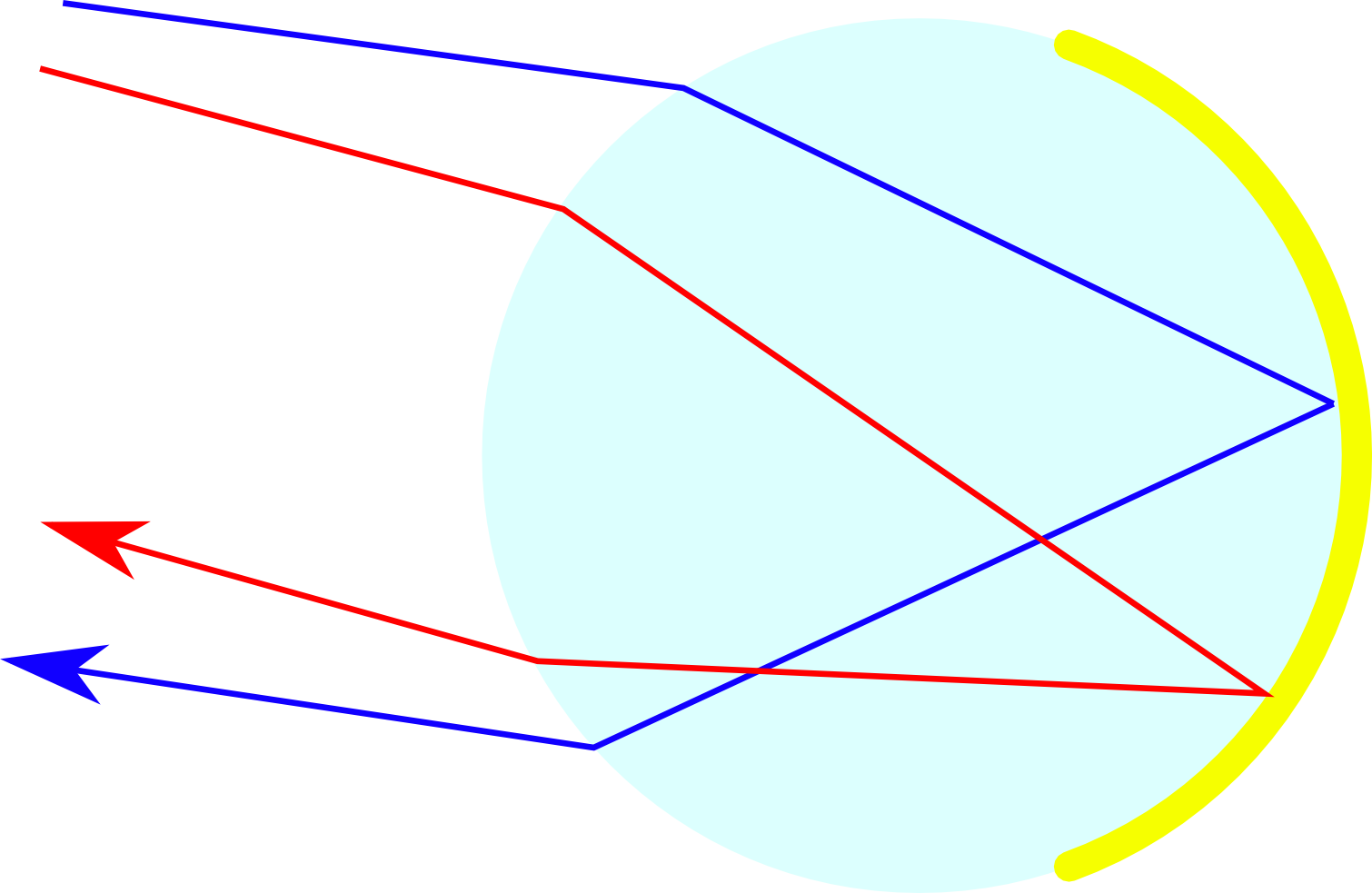 Cat’s eyes retroreflectors can be found on some road markers and….cats. I can’t really find any more examples. This effect does appear in many animals, so if you want to call them dog’s eyes, raccoon’s eyes, llama’s eyes, or cow’s eyes, be my guest.

More commonly seen man-made reflectors are called corner reflectors. These crafty structures are designed to bounce incoming light around and spit it back out in the direction it came. Three 90 degree corners are placed together, resulting in well…a corner.


These are usually made by producing a structure like a truncated cube out of clear glass or plastic, and lining the back surface with a reflective material. Line a bunch of retroreflectors together in a tessellating pattern, and you’ve created a whole sheet that has the bulk property of each reflector. Now, any light that you shine on it will come directly back at the source. This type of retroreflector is used pretty much everywhere. You’ll find it on road signs, but also on cars, running shoes, bikes, and on the Moon. More on that later.

If it seems like a bad idea that the light would only reflect back at the headlights of a car, don’t worry, road signs are designed so that the observer doesn’t have to be right where the source is, but at least somewhat near. That way, road signs can reflect back into the eyes of the driver.
The Physics
Okay, so the Moon.
What do road signs have in common with it? During the Apollo 11, 14, and 15 missions in the late 60’s and early 70’s, astronauts planted several retroreflector arrays on the surface of the Moon. Lasers are then fired at these arrays from Earth, which then return some time later. It’s not very complicated, but we can then calculate the distance between Earth and the Moon with this equation:

where 


It’s quite simple, but that simple formula has allowed us to measure this distance with good accuracy. Over the years, considerations about things like humidity, orbital motion, propagation through atmospheres, weather, and a whole host of other factors has allowed to really fine tune this measurement. What we’ve found:
- The trip there and back takes about 2.5 seconds, so the Moon is 1.25 light seconds way from Earth.
- The distance between Earth and the Moon is about 384,467 km on average. It changes due to several factors, but mostly that the Moon moves away from and toward the Earth all the time.
- Our Moon is moving away from us at 3.8 cm every year.
- Confirmations about the force of gravity and general relativity can be made from this data.
By the time laser beam reaches the Moon, it’s already 6.5 km wide, but aiming it at the retroreflectors is still a precision task. Keep in mind, the Earth and Moon are both moving during this, and it’s hard to know when you’ve succeeded because so little of the light returns to the observer over that distance. Thankfully, we can distinguish the laser light from other signals because it is so monochromatic (meaning that the color of the light is all the same, and is very distinct). Scaled down, this is one of the most precise distance measurements ever made. Just imagine if you could have been so precise when you made that birdhouse as a kid.
I like to imagine that the LLRE predated the modern road sign, and that NASA has once again invented an everyday object. Road signs then, could join the ranks of esteemed inventions like Tang, velcro, and international relations.
 The Physics Behind



If I’m not mistaken in English
•The trip there and back takes about 2.5 seconds, so the Moon is 1.25 light seconds way from Earth.
Thanks for the articles, they’re great!
LikeLike